Every Friday night, it was the same scene.
My father would say the blessing over the bread. A quiet moment. Ritual. Tradition.
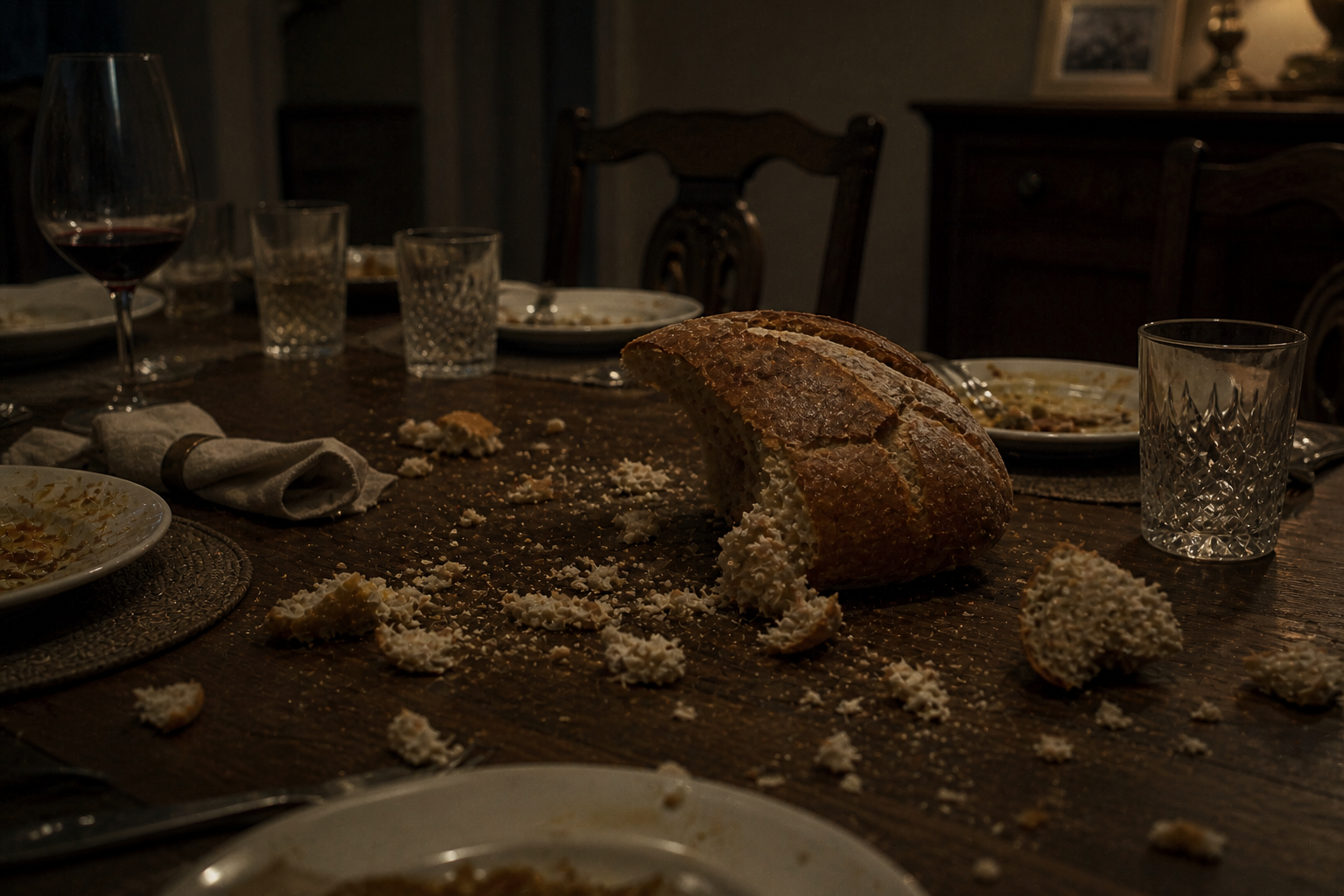
Then, instead of passing it, he would tear it into pieces and toss it across the table. Not gently. Toss it.
My mother would react immediately, irritated, asking him to stop, and he would do it anyway.
Every week. It repeated for years. Same ritual, same reaction, same disregard.
Eventually, my mother adapted. She bought a small dustpan and brush to sweep up the crumbs, a practical solution to a problem that never got resolved.
Nothing changed.
The tension stayed.
As a kid sitting at that table, I didn’t have language for it, but something about it was clear.
Boundaries were not fixed lines. They were something people played with. You pushed them, leaned on them, crossed them a little, then a little more, and then you watched to see what would happen.
How much would it take? How far could you go before the reaction changed? Before irritation turned into something sharper, louder, more intense, that moment when the emotion finally broke through?
That was the real line.
Not the first “please stop,” not the irritation. The line was wherever the emotion became strong enough to land. Until then, the boundary didn’t hold.
What was real were the emotions. The irritation, the anger, the friction in the room week after week. Strong emotions were unavoidable. You just had to live with them.
But the boundary itself was negotiable.
And it made no sense to me.
I remember thinking, even then, either accept it or stop it. If it matters, take a stand. If you’re not going to enforce it, let it go.
But watching the same conflict play out with no resolution created something else in me. Confusion about boundaries, about consistency, about love.
Because here was the part I couldn’t reconcile.
If you love someone, why keep doing something that causes them distress? And if you’re distressed, why not act in a way that actually stops it?
Nothing lined up.
What I didn’t understand then is that I wasn’t just watching a family pattern. I was watching how behaviour gets shaped, regardless of what was being said or what limits were being expressed, long before I had the language for it. That became a driving force in my life and work, a commitment to understanding what drives people to do what they do, and helping others see it for themselves.
In DBT, the principle is straightforward:
What gets reinforced gets repeated.
At that table, the pattern was clear. The boundary didn’t stop the behaviour, the reaction sustained it, not intentionally, but reliably.
Over time, this teaches something specific: that boundaries function as signals, not limits. That “stop” does not necessarily mean stop. That the effective line is emotional intensity, not agreement.
Relationships can begin to organize around this pattern. One person pushes, the other reacts, and the reaction becomes part of what keeps it going. When boundaries are not held, they do not disappear. They are replaced by escalation.
Loving Anger – In my work now, I sometimes use the phrase loving anger, not as a contradiction, but as a distinction.
Anger is the emotion that organizes protection. It prepares the body to act, to set a limit, to stop something that matters. But when the other person is not an enemy, when it is your partner, your child, someone you love, the goal is not to let things build until anger takes over. It is to act before that point, to use the signal of anger to set the boundary clearly without escalation.
Because once it reaches the point of losing control, the boundary is no longer guiding the interaction, the emotion is. And what DBT makes explicit is this: a boundary is not defined by how strongly it is expressed; it is defined by what happens next. If nothing changes, the boundary does not hold, and when that repeats over time, it shapes expectations about what it takes to be taken seriously.
At some point, the question stops being “Why are they doing that?” and becomes “What actually changes when I say stop?” Because if the answer is nothing, the pattern already has its answer.
Just like that table. The bread gets thrown, the reaction comes, and the boundary, once again, does not land.