
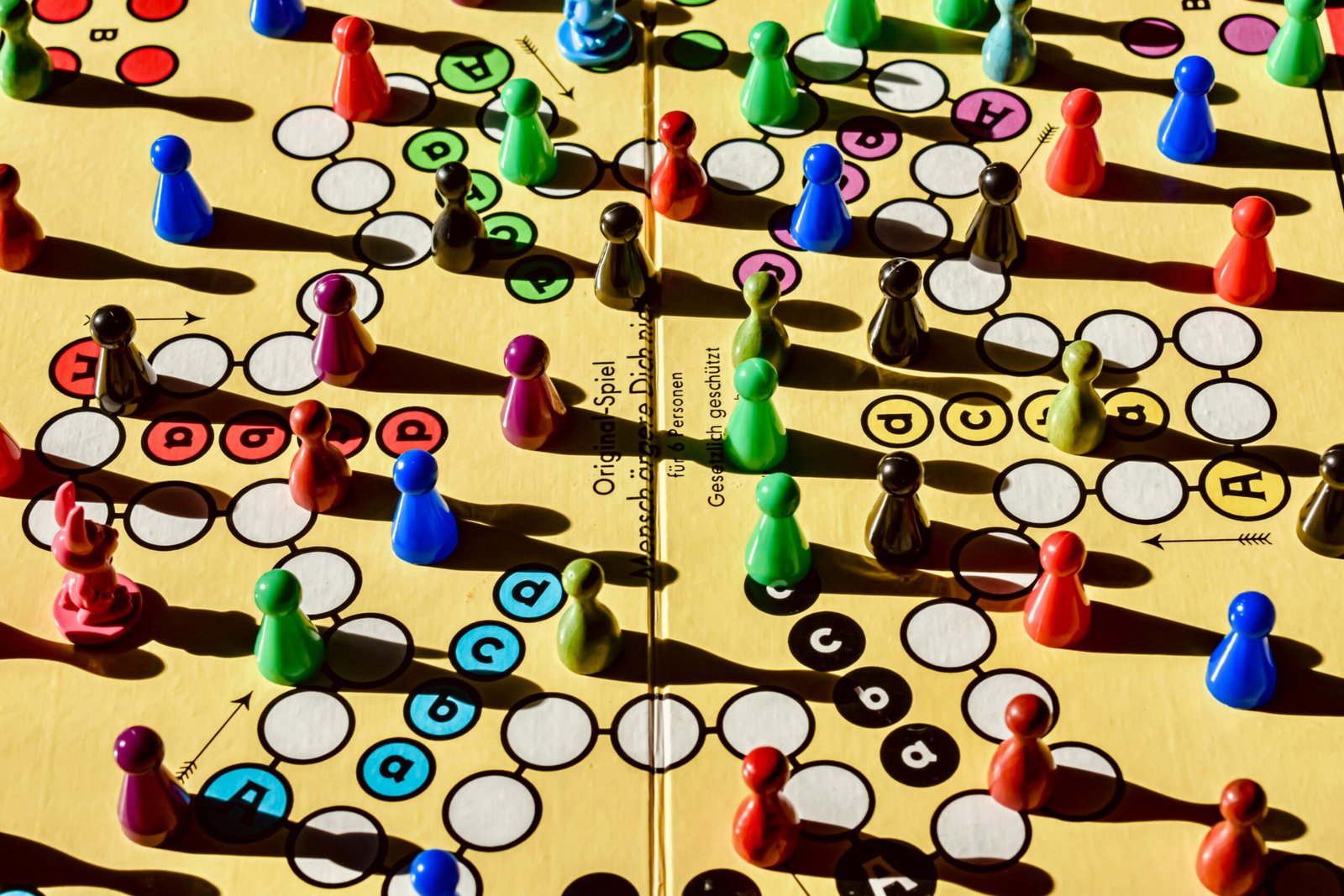
Human beings are not neutral. We are born with emotional systems that shape how we respond to the world. Fear alerts us to danger. Anger prepares us to defend ourselves. Attachment draws us toward others for comfort, protection, and connection. Pleasure, curiosity, and play motivate us to explore and engage with the world. These emotional capacities are part of our evolutionary inheritance.
From the moment we are born, we begin learning how to play the game of life. We learn how to get our needs met, avoid harm, and pursue the things that make life satisfying and meaningful. We learn when to compete, when to cooperate, and how to navigate relationships with others. Much depends on the environment in which we grow up. Scarcity can intensify competition, while shared resources and mutual dependence can encourage cooperation. The behaviours that succeed are shaped by the conditions around us.
Those conditions include both our physical circumstances and our culture. Families, communities, and societies establish the rules of the game: which behaviours are rewarded, which are permitted, and which carry penalties.
Throughout human evolution, our survival has depended on our ability to compete and cooperate, often at the same time. We competed for limited resources, defended ourselves against threats, and protected our families and communities. We also survived by sharing resources, caring for one another, and accomplishing together what individuals could never achieve alone. Cooperation within groups helped us compete with other groups, strengthening our attachment to those we considered part of our group while sometimes reinforcing fear and distrust of outsiders.
As human societies grew larger and more complex, the conditions of survival changed. For most of our history, human populations were separated by enormous distances, with limited contact or influence over one another. Today, we live in a globally interconnected world where billions of people can communicate, compete, and cooperate across vast distances almost instantaneously. What happens in one part of the world can now affect people everywhere.
Some rules of the game are established by nature. Gravity operates regardless of what we believe. Droughts, limited resources, and other physical conditions place constraints on how we live. But many of the rules governing human behaviour are created by us, through our cultures, laws, institutions, and social expectations.
What is acceptable in one culture may be discouraged or punished in another. What one generation considers normal, another may consider unacceptable. In some cultures, parents may be criticized for failing to physically discipline their children. In Canada, parents can face criminal charges for forms of physical punishment once widely accepted, such as hitting a child with a belt. As our values change, so do the rules, rewards, and penalties that shape our behaviour.
These human-made rules matter because they influence whether competition or cooperation becomes more advantageous. And because we create them, we have the capacity to change them.
The Robbers Cave Experiment
In the Robbers Cave Experiment, researchers divided boys at a summer camp into two groups and introduced competitions with prizes and rewards. Hostility quickly developed. Name-calling escalated into aggression, and the boys began treating members of the other group as enemies.
As the hostility escalated, the researchers ended the competitive activities. But the hostility continued.
Simply bringing the groups together for shared activities failed to resolve the conflict. The researchers then introduced problems that neither group could solve alone. The boys had to work together to achieve goals that benefited both groups. Gradually, hostility decreased and relationships began to improve.
The boys hadn’t changed. The rules of the game had.
Once adversarial relationships become established, removing the competition does not necessarily remove the hostility, resentment, and desire for retaliation it created. Restoring cooperation requires actively changing the conditions under which people interact.
The same forces that shaped the boys’ behaviour continue to operate throughout modern society. We compete for jobs, wealth, resources, status, and influence. The rules established by our cultures and institutions influence how we compete, what constitutes success, and who benefits from winning.
Game theory offers a way to understand how different rules produce different outcomes. In a zero-sum game, one person’s gain comes at the expense of others. In a win-win game, participants benefit together. And in a lose-lose game, everyone ends up worse off.
Competition and cooperation can exist within the same game. A business can reward individual achievement while also ensuring that the people whose work contributes to its success share in the benefits. The rules determine whether success produces a few very wealthy winners or improves the lives of many people.
Consider how executive compensation is determined. Corporate boards can award executives substantial bonuses and stock-based compensation tied to company performance, while employees may have little opportunity to share in those same financial gains.
The historical trend in executive compensation illustrates the growing disparity. In 1965, CEOs at major American companies earned approximately 21 times as much as typical workers. By 2025, that figure had grown to 325 times. At Walmart, the CEO’s compensation was nearly 1,000 times that of its median employee.
These differences reflect how we have chosen to distribute the rewards of success. The rules of the game have increasingly favoured those at the top, allowing them to capture a growing share of the rewards while those whose work contributes to that success receive comparatively little.
Changing the Rules
The consequences of how we organize competition now extend far beyond the distribution of wealth. Throughout human history, we have become increasingly effective at competing. For much of that history, geographical boundaries limited the reach and consequences of our conflicts. Today, technology has largely removed those boundaries. We can compete and engage in conflict with people anywhere in the world, while the consequences can extend far beyond those directly involved. We now find ourselves playing a game in which everyone can lose everything, including people who never chose to participate.
In the Robbers Cave Experiment, researchers had both the authority and the ability to change the rules. But in the game of life, who gets to establish those rules?
Throughout history, religious authorities, governments, and powerful institutions have shaped the rules under which people live. Today, corporations and technology companies exercise enormous influence over those rules. Algorithms shape much of what we see, what receives attention, and what behaviours are rewarded. Increasingly consequential decisions are being made by relatively few people, while everyone else lives with the consequences.
We need a greater collective role in deciding who establishes the rules and whose interests they serve. The longer we allow competition to concentrate wealth and power in the hands of a few, the greater the risk of inequality, conflict, and catastrophic consequences. We can deliberately create a game in which individual success benefits more people and cooperation is rewarded, or wait until the consequences of our competition become so destructive that cooperation is necessary for our very survival.